Uncategorized

Man in hospital bed dealing with hiccups that won’t go away, reflecting exhaustion and search for relief
Sometimes it isn’t just about stopping the hiccups… it’s about finally being heard.

If you’re dealing with hiccups that won’t go away, you’ve probably already tried everything.

Holding your breath.
Drinking water upside down.
Sugar.
Startling yourself.

And still… the hiccups stay.

At first, they’re annoying.
Then they’re exhausting.
And after a while, they can feel almost… personal.


Because when something so simple won’t stop, the mind starts asking questions.

What is wrong with me?
Why won’t my body just stop this?


Let me gently reassure you:

There may be nothing “wrong” with you at all.


When hiccups become a pattern

Most people think of hiccups as purely physical.

And sometimes they are.

But when hiccups won’t go away, something else is often happening beneath the surface.

The body has created a loop.

A repeating pattern in the nervous system.

Like a song that got stuck on one line…
and keeps replaying itself, even though no one wants to hear it anymore.


And here’s the important part:

The body isn’t trying to frustrate you.

It’s trying to complete something.

But instead of completing… it repeats.


Why the usual tricks stop working

All those common remedies?

They’re actually attempts to interrupt the pattern.

Sometimes they work—briefly.

But if the underlying loop is strong enough,
the hiccups return… because the pattern is still there.


When nothing seems to work anymore

Over the years, I’ve worked with people whose hiccups lasted far longer than they ever expected.

Not because they were doing something wrong…

But because their system had simply gotten stuck.

In some cases, hiccups become more persistent, forming a pattern that doesn’t easily resolve…


I remember one man who reached out to me from a hospital bed in the UK.

Yes… the UK.

He had tried everything available to him medically, and nothing had worked. By the time he found me, he wasn’t curious—he was worn down.

And that’s often when people come to me.

Not at the beginning…
but at the point where they are ready for something different.


Where hypnosis fits in

When someone comes to me for hypnosis for hiccups, we’re not fighting the body.

We’re working with it.

Hypnosis allows the nervous system to step out of that repeating loop—
to pause…
to reset…
and to finally complete what it has been trying to complete.


Not by force.
Not by control.

But by creating the conditions where the pattern no longer needs to continue.


And when that happens…

The body often knows exactly what to do next.


A different possibility

If you’re dealing with hiccups that won’t go away,
and nothing you’ve tried has worked for long…

You are not strange.
You are not broken.

You may simply be caught in a pattern that hasn’t been interrupted yet.


And that’s something we can work with.


👉 Learn more about my approach to hypnosis for hiccups here:

Homemade strawberry rhubarb lattice pie baked for Pi Day Short, descriptive, and natural.

Why curiosity, creativity, and a slice of pie belong in the same conversation.

Every year on March 14 — Pi Day (3.14) — mathematicians celebrate the mysterious number that describes the relationship between a circle’s circumference and its diameter. This year, let’s explore Pi Day pie and the power of the mind, and how the celebration can inspire both mathematical curiosity and creativity.

Bakers celebrate something even better.

Pie.

And today in my kitchen, the celebration includes one of my favorites: strawberry rhubarb pie.

Pi is fascinating because it never ends. Its digits continue infinitely without repeating.

In many ways, the human mind behaves the same way.

For more than 25 years as a clinical hypnotherapist in Palm Harbor, Florida, I have watched people discover abilities within themselves that they didn’t know were there. When the mind relaxes and becomes curious instead of fearful, new pathways often begin to appear.

Sometimes the change is subtle.

Sometimes it is dramatic.

People come to see me believing they are “stuck” with something:

  • anxiety that seems to appear without warning
  • habits they can’t seem to break
  • fears that make no logical sense
  • even unusual physical responses like chronic hiccups

Yet when the mind is given the right conditions, it often begins to reorganize itself in surprising ways.

That is one of the remarkable things about hypnosis.

Many people imagine hypnosis as something mysterious or unusual. In reality, hypnosis is simply a natural state of focused attention — something the mind enters many times every day while reading a book, driving a familiar road, or becoming absorbed in a story.

When that focused state is used intentionally, it can help the mind access resources that are normally operating quietly beneath the surface.

Just like Pi, the possibilities inside the mind are far more expansive than most people realize.

That’s one of the reasons I enjoy small traditions like baking on Pi Day.

There is something wonderfully grounding about the simple process of making pie: measuring ingredients, rolling dough, smelling fruit and sugar as it bakes.

In a world that moves very quickly, moments like these remind us that curiosity and creativity are part of healing too.

And sometimes the most meaningful discoveries happen when we slow down long enough to notice what the mind is capable of doing for us.

Traditions often live quietly in the kitchen. This strawberry rhubarb pie is one of them in our house. It’s my husband’s favorite because his Granny used to grow the strawberries and rhubarb herself and bake pies for him. My version leans a little more strawberry-forward, with a splash of orange juice and orange zest to brighten the fruit. When the pie comes out of the oven and the kitchen fills with that familiar smell, it feels like those memories are still very much alive.

So today I’ll enjoy a slice of strawberry rhubarb pie.

And I’ll remember something I have witnessed countless times in my office:

As a clinical hypnotherapist in Palm Harbor, I’ve spent more than 25 years helping people discover how powerful the mind can be when it learns to relax, focus, and work with its natural abilities. When the mind becomes curious rather than afraid, remarkable things often begin to happen.

Just like Pi…

the possibilities continue.

Debbie Lane, C.Ht.
Debbie Lane’s Wisdom Hypnosis
Palm Harbor, Florida

Helping people discover the healing within.

Curious about how hypnosis works?

You can explore a free guided hypnosis audio here

If you would like to learn more about hypnosis for hiccups and other mind-body responses, you can read more here

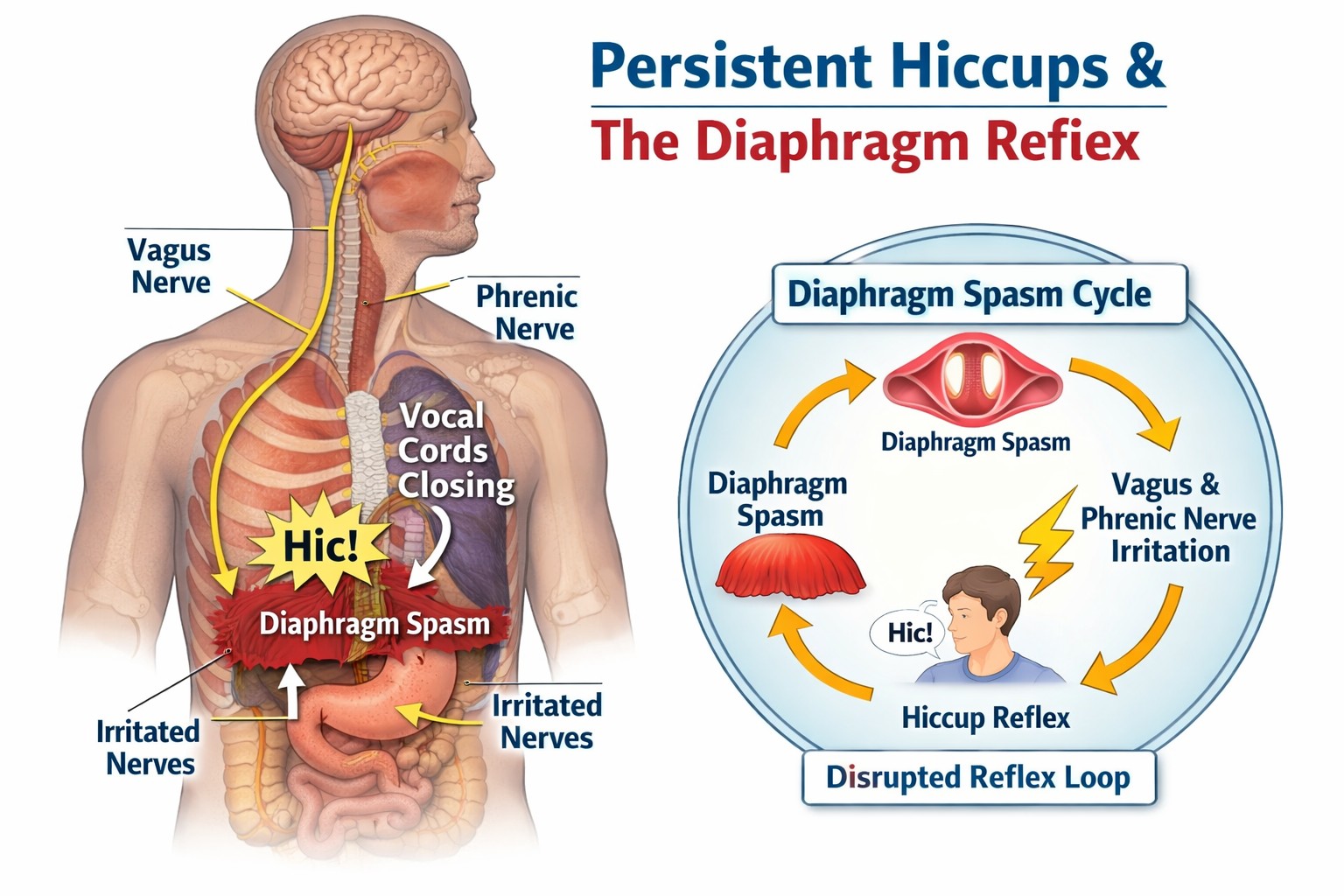
Persistent hiccups diagram showing diaphragm spasm cycle involving the vagus nerve and phrenic nerve.

For individuals dealing with stubborn hiccups that have continued for days or longer, hypnosis is sometimes explored as a way to help reset the diaphragm reflex cycle.

You can read more about how this approach works here:

A Mind-Body Connection

The diaphragm works closely with the nervous system to control breathing and the reflex that produces hiccups. Techniques that promote relaxation and focused attention may help the body settle out of repetitive reflex patterns.

If you’ve been dealing with hiccups for days or weeks, you already know how exhausting and frustrating they can be. Many people contact me after they’ve tried everything else and simply want the reflex to stop.

Hypnosis works by calming the nervous system and helping the body settle out of the diaphragm reflex loop that produces hiccups. Some people find that helping the body relax and interrupt the reflex cycle can bring welcome relief.

Call 727-215-0283 to schedule a consultation

Because persistent hiccups can have many possible causes, it is always important to consult a physician. This applies if hiccups last longer than 48 hours.

After doctors rule out medical causes, some people explore ways to calm the nervous system and interrupt the hiccup reflex. Additionally, they try to interrupt the hiccup cycle.

Final Thoughts

Most hiccups are temporary and harmless. But persistent hiccups can be frustrating and exhausting.

If hiccups continue for days or weeks, seeking medical advice is the first step. After doctors rule out medical causes, some people explore approaches that may help calm the nervous system and reset the hiccup reflex.

If you or someone you know has been dealing with persistent hiccups, learning more about how the hiccup reflex works may be a helpful place to start.

Why Afformations Work in Hypnosis (And Why I Use Them Instead of Affirmations)

If you’ve ever tried affirmations and felt frustrated, resistant, or quietly annoyed, you’re not alone. Many thoughtful, self-aware people discover that traditional affirmations don’t soothe the mind—they provoke it.

In my hypnosis practice, I use afformations instead. They work with the brain, not against it, and they integrate seamlessly into therapeutic hypnosis.

This article explains what afformations are, why they work, and how I use them in hypnosis to support lasting change.


What Are Afformations?

Afformations are positive, assumption-based questions rather than declarative statements.

  • Affirmation: “I am calm.”
  • Afformation: “Why am I beginning to feel calmer now?”

Instead of instructing the mind what to believe, afformations invite the subconscious to explore a constructive direction. The brain naturally responds to questions by searching for answers.

This simple shift dramatically reduces resistance.


Why Affirmations Often Don’t Work

Affirmations can be effective for some people—but for many, especially those who are introspective, analytical, or emotionally nuanced, they create internal friction.

When a statement feels untrue, the subconscious pushes back:

  • “That’s not how I feel.”
  • “If this were true, I wouldn’t be struggling.”

Rather than creating change, the mind begins arguing. Hypnosis relies on cooperation, not conflict.


Why Afformations Work (The Psychology and Neuroscience)

Afformations align with how the brain already operates.

1. They Activate the Reticular Activating System (RAS)

The RAS filters what we notice and prioritize. When the mind is asked a positively framed question, it begins scanning for evidence that supports it.

“Why is my body learning how to relax more easily?”
This directs attention toward moments of comfort, safety, and release.

2. They Reduce Cognitive Dissonance

Questions don’t demand belief. They invite curiosity. Curiosity is neurologically safer than compliance.

3. They Support a Sense of Agency

Afformations imply process and learning rather than perfection. They respect where the person actually is—while gently guiding where they’re going.


Why Afformations Are Especially Effective in Hypnosis

Hypnosis is a state of focused attention, reduced critical resistance, and heightened receptivity to meaningful language.

In this state, how something is said matters as much as what is said.

Afformations work beautifully in hypnosis because they:

  • Feel natural to the subconscious mind
  • Encourage inner discovery rather than obedience
  • Allow the client’s own nervous system to find its answers

Rather than installing beliefs, afformations evoke internal knowing.


How I Use Afformations in Hypnotherapy

During hypnosis sessions, afformations are woven into breath, imagery, and bodily awareness. They are offered slowly, with space—so the subconscious can respond organically.

Examples include:

  • “How does your body know how to settle itself now?”
  • “What part of you already understands how to feel safe again?”
  • “Why is it becoming easier to trust your own timing?”

Clients don’t need to consciously answer these questions. The subconscious responds through sensation, emotion, memory, or a quiet sense of ease.


Afformations and Client-Centered Hypnosis

I choose afformations because they reflect a deep respect for the client.

They assume that the person is:

  • Adaptive rather than broken
  • Insightful rather than deficient
  • Capable of self-directed healing

This philosophy aligns with therapeutic hypnosis, where change is invited—not imposed.


Afformations vs Affirmations: A Gentle Shift That Matters

Afformations don’t command the mind to change. They invite it.

And when the subconscious is approached with curiosity and respect, it almost always responds.


Interested in Hypnosis That Works With Your Mind, Not Against It?

If affirmations have never quite landed for you, afformation-based hypnosis may feel refreshingly different.

This approach honors your intelligence, your nervous system, and your natural capacity for change.

Anxiety doesn’t always announce itself.

IAnxiety doesn’t always show up as panic attacks or racing thoughts that refuse to stop. In fact, for many people, it’s much quieter — and far more persistent.

Instead of chaos, it can look like responsibility. Like thoughtfulness. Like reliability. It shows up as someone who gets things done and holds everything together… while the body never fully rests.

Often, this kind of anxiety goes unnoticed. At times, even the person carrying it doesn’t recognize it, because it has been present for so long that it feels like “just how I am.”

Yet that isn’t your identity.
It’s a nervous system that learned to stay on guard.


The Anxiety of High Functioning

Many of the people I work with appear to be doing “fine” by outside standards. They are caregivers, professionals, helpers, parents, and partners. Planning ahead comes naturally. Needs are anticipated. Rarely do they fall apart in public.

Beneath that capability, however, there is exhaustion.

Although the mind may understand that everything is safe, the body hasn’t caught up. Logic alone hasn’t resolved it — not because you are failing, but because this kind of anxiety doesn’t live in the thinking mind. Instead, it lives in the nervous system.

It often whispers:

“If I relax, something will go wrong.”
“I need to stay alert.”
“I can rest later.”

And somehow, later rarely comes.


Why “Managing” Anxiety Isn’t the Same as Settling It

Many capable people become highly skilled at managing themselves. Coping tools, distraction, reassurance, and self-talk all have value. Still, something essential may remain untouched.

An anxious nervous system doesn’t want to be corrected.
More than anything, it wants to feel safe.

Real settling happens gradually. It unfolds gently and through repetition. Progress emerges when no one rushes you, demands immediate change, or treats anxiety like an enemy to eliminate. Instead, it can be understood as a protective pattern that once made sense — and now deserves to soften.


What This Kind of Support Looks Like

The work I do isn’t about fixing you or pushing you beyond your limits. Rather, it’s about creating enough steadiness that your system can begin to stand down on its own.

That may include:

  • Moving at a pace your body can trust
  • Allowing silence without pressure
  • Welcoming sessions that feel “uneventful”
  • Releasing the need to perform healing correctly

Over time, anxiety loosens — not because it was fought, but because it no longer needs to remain on duty.


If This Feels Familiar

Perhaps you carry anxiety quietly.
Maybe you function well yet feel internally braced.
Or perhaps you are simply tired of holding yourself together.

You are not broken.
You are not behind.
There is nothing you need to justify about how you feel.

Another way of relating to anxiety exists — one grounded in safety, patience, and respect for your nervous system.

I currently have a limited number of openings for those who feel ready for that kind of work.

Sometimes meaningful change begins not with more effort, but with finally being allowed to rest.

The current image has no alternative text. The file name is: hypnosis-for-new-years.png

Every December, millions of people set resolutions with sincere hope:
This year I’ll lose the weight.
This year I’ll manage my stress.
This year I’ll improve my finances, my energy, my relationships.

And yet… by mid-February, most resolutions have quietly slipped away.

But here’s the truth many people never realize:
Resolutions don’t fail because people lack willpower.
Resolutions fail because the conscious mind—where willpower lives—cannot override the deeper subconscious patterns that have been running for years.

This is exactly where hypnosis becomes the secret advantage.


Why Hypnosis Works When Willpower Doesn’t

Your conscious mind sets the goal.
Your subconscious controls the habits.

When the two conflict, the subconscious wins every time.

Hypnosis creates the bridge between them. It gently shifts the subconscious patterns that drive behavior so your goals stop feeling like a fight and start feeling natural.

For example:

1. Hypnosis Reduces the ‘Internal Resistance’

If a person wants to exercise but their subconscious associates exercise with embarrassment, failure, or discomfort, they’ll always find reasons not to go.
Hypnosis rewrites the emotional meaning so the behavior feels safe, familiar, even appealing.

2. Hypnosis Removes Old Self-Sabotage Patterns

Procrastination, perfectionism, fear of success, and fear of change often operate below awareness.
Through trance, clients can release those patterns and adopt healthier ones.

3. Hypnosis Strengthens Follow-Through

Resolution success depends on consistency. Hypnosis reinforces repetition, motivation, and self-trust — the invisible glue of habit.

4. Hypnosis Helps People Step Into a New Identity

Long-term change requires an identity shift.
Want to exercise? Become “a person who moves.”
Want to save money? Become “a person who manages money confidently.”

Hypnosis is one of the fastest ways to shift identity from the inside out.


The Magic of January: Why the New Year Is the Perfect Time

January carries a natural psychological fresh-start effect.
People feel hopeful, willing, and open.

Hypnosis works beautifully in this window because:

  • The subconscious is already primed for change
  • People feel motivated to take action
  • Identity is in a state of transition

It’s the moment when change is easiest — and when support matters most.


What Your First Hypnosis Session Looks Like

Clients often imagine hypnosis as mysterious or intense, but my sessions feel more like a guided conversation with your deeper mind.

A typical first session includes:

  • Understanding your resolution and what’s blocked you in the past
  • Identifying the emotional or subconscious patterns that need shifting
  • Relaxation to access a receptive trance state
  • Targeted suggestions to support the new behavior
  • A post-session plan to help habits become automatic

Most clients leave the first session feeling lighter, clearer, and more in control.


This Year Can Be Different

If you’ve made the same resolution year after year, and you’re ready for this to finally be the year it sticks, hypnosis can help you follow through with confidence, calm, and clarity.

You don’t have to fight your subconscious.
You can partner with it.

And when your subconscious supports your goals,
success becomes inevitable.

To book your appointment for success Click Here

or call: 727-215-0283

Prism creating rainbow heart on paper.

When one way of understanding your pain isn’t enough, consider looking through healing lenses for a different perspective.

Sometimes life cracks your world wide open.
A loss. A tragedy in the news. A violent act that leaves you trembling.

A modern living room with a white sectional sofa and large windows.

In moments like these, you may find yourself asking, “Why? How do I even begin to make sense of this?”
You might swing between rage and grief, numbness and confusion, trying to grab hold of something steady.

What I’ve learned is this:
There isn’t just one right way to understand pain.
Sometimes, the most healing thing you can do is to let yourself look through many different lenses–not to deny what happened, but to find enough light to keep going.

The Spiritual Lenses

For some people, comfort begins with faith.

  • Through the eyes of Jesus, you might hear: “Blessed are those who mourn, for they shall be comforted.” His words offer tenderness and the reminder that love and forgiveness are stronger than hatred.
  • Through the eyes of the Buddha, you might hear: “Hatred never ends hatred. Only love can do that.” Instead of feeding rage, he invites you to place it down gently, like a burning coal.
  • Through the eyes of Rumi, the poet, you might hear: “The wound is the place where the Light enters you.” Your heartbreak doesn’t mean you are broken – it means your heart is still deeply alive.
  • And sometimes, it’s the voice of the Divine Mother – Mary, Quan Yin, Tara – that you need most: “Cry. Rage. Collapse in my arms if you must. I will hold you.”

These voices don’t erase the pain.
They simply whisper that you don’t have to carry it alone.

The Philosophical Lenses

Others find comfort in clarity rather than comfort.

  • Nietzsche said: “Beware that, when fighting monsters, you yourself do not become a monster.” Rage can be tempting, but if you hold it too long, it can hollow you out.
  • The Stoics remind us: “You can’t control what others do. You can only choose who you will be.”
  • Existentialists like Camus say: life doesn’t always make sense, but we can still choose love, beauty, and courage in the middle of the chaos.

These perspectives don’t tell you everything will be okay.
They remind you that even when it’s not okay, you still have power over who you become.

The Emotional / Trauma Lens

Sometimes the most helpful thing is simply understanding what your body is doing.

Rage, grief, and numbness are not signs that you’re “doing it wrong.”
They are normal nervous system responses to shock and danger.

Your body might be trying to protect you with fight, flight, freeze, or collapse.
That’s not weakness – that’s biology.

Through this lens, healing begins with safety, grounding, and compassion for yourself.
Breath. Warmth. Gentle routines. Calming your body enough that your heart can even begin to heal.

The Ancestral and Cultural Lenses

In many traditions, a sudden death or act of violence isn’t seen as just an individual wound – it’s seen as a tear in the fabric of the whole community.

The response isn’t “get over it,” but gather together.
Tell stories. Light candles. Cook food. Weep.
Remember the one who was lost.

This lens reminds us:
You don’t have to carry this pain alone.
You are part of something larger and older than this moment.

The Feminine / Mothering Lens

Sometimes, you don’t need perspective at all.
You just need comfort.

This lens says: “You don’t have to rise above this yet. You just need someone to hold you while you fall apart.”

It might look like soft blankets. Soup on the stove. A friend’s voice on the phone.
Not fixing – just holding.

This kind of love doesn’t ask you to be strong.
It lets you be human.

The Activist / Purpose Lens

Some people only find their way through pain by doing something with it.

  • Speaking up.
  • Protecting someone else.
  • Volunteering.
  • Creating beauty where there was harm.

This lens says: “I can’t undo what happened, but I can grow something good from this ground.”

It turns anguish into action – not to erase the pain, but to give it meaning.

A Real Example

One woman I worked with had witnessed a sudden, violent act. She was drowning in anger.

“I know I’m supposed to be compassionate,” she said, “but all I feel is fire. If I let go of the anger, I’m afraid it will mean what happened didn’t matter.”

We started by understanding her rage as a trauma response, not a character flaw.
Once her body felt safe, she could finally let the tears come.

Then, she found peace in Jesus’ promise that those who mourn will be comforted.
She softened her fury through the Buddhist view that hatred only creates more suffering.
She reclaimed her power with the Stoic reminder that she still had choice over who she wanted to be.
And finally, she found healing by stepping into the activist lens, quietly mentoring at-risk teens so someone else might be spared that kind of pain.

None of those lenses alone would have been enough.
But together, they gave her room to breathe – and eventually, to heal.

Why Many Lenses Help

Here’s the truth:
No single way of seeing can hold all of your pain.

When you only have one explanation – one lens – it can crack under the weight of what you’re feeling.
But when you gently move between lenses, something opens.

It’s like walking around a sculpture in a museum.
From one side, you see grief.
Yet, from another, courage.
Still from another, love.

Each view shows something the others cannot.

That movement – that willingness to see differently – is how the mind and heart begin to loosen their grip on despair.

If You Are in the Dark Right Now

If you are carrying heartbreak today, here is what I want you to know:

  • You are not weak for feeling anger or grief.
  • You do not have to “choose just one” way to heal.
  • You can hold your pain like a prism, turning it gently in the light.
  • On some days, faith might help.
  • On others, reason might steady you.
  • On still others, you might need a soft blanket and someone who won’t ask you to be strong at all.

All of it is allowed.
All of it can be part of your healing.

Closing

Grief can make the world go dark.
Rage can make it burn.

But shifting the lens–even slightly–can let the light back in.

You don’t have to find the answer right now.
Just find a lens that helps you breathe for this moment.
And then, when you’re ready, another.

Your healing is not in one answer – it’s in the freedom to see your pain through many eyes, until one of them shows you peace.

If your heart is heavy right now, you don’t have to carry it alone.
When you’re ready, reach out. Together we can explore the many lenses that can help you heal.

To begin your healing journey call: 727-215-0283

client relaxes in Wisdom Hypnosis session

In the quiet of my office, something sacred happens.

Clients don’t always come to me because they believe in hypnosis. Often, they come because something else hasn’t worked—medications, talk therapy, sheer willpower. They come because they’re in pain. Emotional. Physical. Spiritual. And somewhere deep inside, they’re still hoping for relief. For change, for a way home to themselves.

That’s where the healing begins.

Hypnosis is Not Sleep

Not only is hypnosis not sleep, it’s also not mind control. It’s a gentle shift in awareness—one that opens a door between the conscious mind and the deeper self. In that space, the body softens. The breath deepens. Old fears loosen. This form of awareness could be described as a form of hypnosis, where new possibilities begin to root.

For some, it’s the release of trauma stored in the nervous system. For others, it’s a quiet reintroduction to peace, perhaps for the first time in years. I’ve witnessed chronic hiccups silenced and I’ve seen grief begin to melt under the warmth of self-compassion. I’ve watched people rediscover their strength, their voice, and their worth.

Hypnosis is not magic but hypnosis is sacred

Hypnosis, at its best, is not something I do to someone. It’s a conversation—between the conscious and unconscious, between old stories and new truths. It’s the art of listening deeply enough to hear what the body and soul already know: that healing is not a destination, but a return. A remembering. This process is often an application of hypnosis principles.

I tell my clients: You’re not broken. You’re becoming.

If you’ve been feeling stuck, afraid, exhausted—or simply curious—consider this your invitation. Hypnosis might not be what you expect. But it may be exactly what you need to discover the potential within you.

And in the silence… you just might know.

Call to set up your opportunity to explore how hypnosis can help you heal:

727-215-0283

Sunlight streams through a decorative stained glass window onto a stone wall.

As we step further into the 21st century, our fast-paced world presents unique challenges to our mental, emotional, and physical well-being. In 2025, hypnosis continues to emerge as a powerful tool for personal transformation, stress relief, and health improvement. Whether you’re seeking a way to break free from limiting beliefs, manage chronic conditions, or achieve peak performance, hypnosis helps by offering a safe, effective, and science-backed solution.

Here are 7 uses of hypnosis for you:

1. Mental Wellness in a Busy World

The increasing demands of modern life have led to a significant rise in stress, anxiety, and burnout. Hypnosis provides a pathway to deep relaxation and mindfulness. It helps individuals manage these challenges by calming the mind and reducing the physiological effects of stress. Hypnosis helps to train your mind to focus on positivity and resilience. This gives you the mental edge needed to thrive in 2025.

2. A Natural Solution for Health Challenges

As more people turn to holistic health solutions, hypnosis stands out as a natural, non-invasive approach to managing physical health. In 2025, hypnosis is widely recognized as an adjunct to traditional medical treatments for conditions such as chronic pain, IBS, migraines, and even side effects of cancer treatments. By tapping into the power of the subconscious mind, hypnosis helps individuals create healthier habits and reduces reliance on medication.

3. Overcoming Limiting Beliefs and Habits

Old habits and negative thought patterns often hold us back from reaching our full potential. Whether you want to quit smoking, lose weight, or overcome fears, hypnosis works by reprogramming the subconscious mind. This is where these habits and beliefs are stored. In this way, hypnosis helps you break free from the patterns that no longer serve you and replace them with empowering beliefs.

4. Enhancing Performance and Focus

The competitive nature of today’s world makes personal performance more important than ever. Hypnosis has gained popularity among athletes, professionals, and students for its ability to enhance focus, motivation, and confidence. From improving sports performance to excelling in exams or presentations, hypnosis unlocks the mental clarity and inner drive needed to achieve success. It further proves how hypnosis helps improve performance.

5. A Personalized and Flexible Tool

One of the greatest advantages of hypnosis in 2025 is its adaptability. Sessions can be conducted in person or virtually, allowing clients to access the benefits of hypnosis from anywhere in the world. Techniques are tailored to individual needs, making hypnosis suitable for people of all ages and backgrounds. Clearly, hypnosis helps by being a flexible option.

In 2025, hypnosis is no longer shrouded in mystery–it is recognized as a legitimate therapeutic approach supported by organizations such as the American Psychological Association (APA) and the National Institutes of Health (NIH).

6. Backed by Science and Growing Awareness

The scientific foundation of hypnosis continues to expand, with research demonstrating its effectiveness for a wide range of issues. In 2025, hypnosis is no longer shrouded in mystery–it is recognized as a legitimate therapeutic approach supported by organizations such as the American Psychological Association (APA) and the National Institutes of Health (NIH). Its credibility has also grown thanks to advancements in neuroscience. Studies using functional MRI reveal how hypnosis affects the brain, showing how hypnosis helps in various ways.

7. Empowering Self-Discovery

At its core, hypnosis is a journey into your inner world. It helps you reconnect with your authentic self. It also helps uncover hidden strengths and align your actions with your values. In 2025, more individuals are embracing hypnosis as a tool for self-discovery, healing, and transformation in a world that often pulls us away from our true selves.

Conclusion: Why Wait?

In 2025, hypnosis is not just a tool for addressing specific problems–it is a pathway to a better life. With its proven ability to transform the mind and body, hypnosis is an investment in your well-being, resilience, and future. Whether you’re looking to reduce stress, break bad habits, or unlock your full potential, hypnosis is here to help you create lasting change. Yes, indeed, hypnosis helps individuals achieve more in life.

Why not make this the year you harness the power of your mind? The possibilities are endless.

A modern living room with a white sectional sofa and large windows.

1 2 3 6