Blog

The current image has no alternative text. The file name is: hypnosis-for-new-years.png

Every December, millions of people set resolutions with sincere hope:
This year I’ll lose the weight.
This year I’ll manage my stress.
This year I’ll improve my finances, my energy, my relationships.

And yet… by mid-February, most resolutions have quietly slipped away.

But here’s the truth many people never realize:
Resolutions don’t fail because people lack willpower.
Resolutions fail because the conscious mind—where willpower lives—cannot override the deeper subconscious patterns that have been running for years.

This is exactly where hypnosis becomes the secret advantage.


Why Hypnosis Works When Willpower Doesn’t

Your conscious mind sets the goal.
Your subconscious controls the habits.

When the two conflict, the subconscious wins every time.

Hypnosis creates the bridge between them. It gently shifts the subconscious patterns that drive behavior so your goals stop feeling like a fight and start feeling natural.

For example:

1. Hypnosis Reduces the ‘Internal Resistance’

If a person wants to exercise but their subconscious associates exercise with embarrassment, failure, or discomfort, they’ll always find reasons not to go.
Hypnosis rewrites the emotional meaning so the behavior feels safe, familiar, even appealing.

2. Hypnosis Removes Old Self-Sabotage Patterns

Procrastination, perfectionism, fear of success, and fear of change often operate below awareness.
Through trance, clients can release those patterns and adopt healthier ones.

3. Hypnosis Strengthens Follow-Through

Resolution success depends on consistency. Hypnosis reinforces repetition, motivation, and self-trust — the invisible glue of habit.

4. Hypnosis Helps People Step Into a New Identity

Long-term change requires an identity shift.
Want to exercise? Become “a person who moves.”
Want to save money? Become “a person who manages money confidently.”

Hypnosis is one of the fastest ways to shift identity from the inside out.


The Magic of January: Why the New Year Is the Perfect Time

January carries a natural psychological fresh-start effect.
People feel hopeful, willing, and open.

Hypnosis works beautifully in this window because:

  • The subconscious is already primed for change
  • People feel motivated to take action
  • Identity is in a state of transition

It’s the moment when change is easiest — and when support matters most.


What Your First Hypnosis Session Looks Like

Clients often imagine hypnosis as mysterious or intense, but my sessions feel more like a guided conversation with your deeper mind.

A typical first session includes:

  • Understanding your resolution and what’s blocked you in the past
  • Identifying the emotional or subconscious patterns that need shifting
  • Relaxation to access a receptive trance state
  • Targeted suggestions to support the new behavior
  • A post-session plan to help habits become automatic

Most clients leave the first session feeling lighter, clearer, and more in control.


This Year Can Be Different

If you’ve made the same resolution year after year, and you’re ready for this to finally be the year it sticks, hypnosis can help you follow through with confidence, calm, and clarity.

You don’t have to fight your subconscious.
You can partner with it.

And when your subconscious supports your goals,
success becomes inevitable.

To book your appointment for success Click Here

or call: 727-215-0283

Prism creating rainbow heart on paper.

When one way of understanding your pain isn’t enough, consider looking through healing lenses for a different perspective.

Sometimes life cracks your world wide open.
A loss. A tragedy in the news. A violent act that leaves you trembling.

A modern living room with a white sectional sofa and large windows.

In moments like these, you may find yourself asking, “Why? How do I even begin to make sense of this?”
You might swing between rage and grief, numbness and confusion, trying to grab hold of something steady.

What I’ve learned is this:
There isn’t just one right way to understand pain.
Sometimes, the most healing thing you can do is to let yourself look through many different lenses–not to deny what happened, but to find enough light to keep going.

The Spiritual Lenses

For some people, comfort begins with faith.

  • Through the eyes of Jesus, you might hear: “Blessed are those who mourn, for they shall be comforted.” His words offer tenderness and the reminder that love and forgiveness are stronger than hatred.
  • Through the eyes of the Buddha, you might hear: “Hatred never ends hatred. Only love can do that.” Instead of feeding rage, he invites you to place it down gently, like a burning coal.
  • Through the eyes of Rumi, the poet, you might hear: “The wound is the place where the Light enters you.” Your heartbreak doesn’t mean you are broken – it means your heart is still deeply alive.
  • And sometimes, it’s the voice of the Divine Mother – Mary, Quan Yin, Tara – that you need most: “Cry. Rage. Collapse in my arms if you must. I will hold you.”

These voices don’t erase the pain.
They simply whisper that you don’t have to carry it alone.

The Philosophical Lenses

Others find comfort in clarity rather than comfort.

  • Nietzsche said: “Beware that, when fighting monsters, you yourself do not become a monster.” Rage can be tempting, but if you hold it too long, it can hollow you out.
  • The Stoics remind us: “You can’t control what others do. You can only choose who you will be.”
  • Existentialists like Camus say: life doesn’t always make sense, but we can still choose love, beauty, and courage in the middle of the chaos.

These perspectives don’t tell you everything will be okay.
They remind you that even when it’s not okay, you still have power over who you become.

The Emotional / Trauma Lens

Sometimes the most helpful thing is simply understanding what your body is doing.

Rage, grief, and numbness are not signs that you’re “doing it wrong.”
They are normal nervous system responses to shock and danger.

Your body might be trying to protect you with fight, flight, freeze, or collapse.
That’s not weakness – that’s biology.

Through this lens, healing begins with safety, grounding, and compassion for yourself.
Breath. Warmth. Gentle routines. Calming your body enough that your heart can even begin to heal.

The Ancestral and Cultural Lenses

In many traditions, a sudden death or act of violence isn’t seen as just an individual wound – it’s seen as a tear in the fabric of the whole community.

The response isn’t “get over it,” but gather together.
Tell stories. Light candles. Cook food. Weep.
Remember the one who was lost.

This lens reminds us:
You don’t have to carry this pain alone.
You are part of something larger and older than this moment.

The Feminine / Mothering Lens

Sometimes, you don’t need perspective at all.
You just need comfort.

This lens says: “You don’t have to rise above this yet. You just need someone to hold you while you fall apart.”

It might look like soft blankets. Soup on the stove. A friend’s voice on the phone.
Not fixing – just holding.

This kind of love doesn’t ask you to be strong.
It lets you be human.

The Activist / Purpose Lens

Some people only find their way through pain by doing something with it.

  • Speaking up.
  • Protecting someone else.
  • Volunteering.
  • Creating beauty where there was harm.

This lens says: “I can’t undo what happened, but I can grow something good from this ground.”

It turns anguish into action – not to erase the pain, but to give it meaning.

A Real Example

One woman I worked with had witnessed a sudden, violent act. She was drowning in anger.

“I know I’m supposed to be compassionate,” she said, “but all I feel is fire. If I let go of the anger, I’m afraid it will mean what happened didn’t matter.”

We started by understanding her rage as a trauma response, not a character flaw.
Once her body felt safe, she could finally let the tears come.

Then, she found peace in Jesus’ promise that those who mourn will be comforted.
She softened her fury through the Buddhist view that hatred only creates more suffering.
She reclaimed her power with the Stoic reminder that she still had choice over who she wanted to be.
And finally, she found healing by stepping into the activist lens, quietly mentoring at-risk teens so someone else might be spared that kind of pain.

None of those lenses alone would have been enough.
But together, they gave her room to breathe – and eventually, to heal.

Why Many Lenses Help

Here’s the truth:
No single way of seeing can hold all of your pain.

When you only have one explanation – one lens – it can crack under the weight of what you’re feeling.
But when you gently move between lenses, something opens.

It’s like walking around a sculpture in a museum.
From one side, you see grief.
Yet, from another, courage.
Still from another, love.

Each view shows something the others cannot.

That movement – that willingness to see differently – is how the mind and heart begin to loosen their grip on despair.

If You Are in the Dark Right Now

If you are carrying heartbreak today, here is what I want you to know:

  • You are not weak for feeling anger or grief.
  • You do not have to “choose just one” way to heal.
  • You can hold your pain like a prism, turning it gently in the light.
  • On some days, faith might help.
  • On others, reason might steady you.
  • On still others, you might need a soft blanket and someone who won’t ask you to be strong at all.

All of it is allowed.
All of it can be part of your healing.

Closing

Grief can make the world go dark.
Rage can make it burn.

But shifting the lens–even slightly–can let the light back in.

You don’t have to find the answer right now.
Just find a lens that helps you breathe for this moment.
And then, when you’re ready, another.

Your healing is not in one answer – it’s in the freedom to see your pain through many eyes, until one of them shows you peace.

If your heart is heavy right now, you don’t have to carry it alone.
When you’re ready, reach out. Together we can explore the many lenses that can help you heal.

To begin your healing journey call: 727-215-0283

debunking hypnosis myths

Hypnosis is a state of focused attention, heightened suggestibility, and deep relaxation that allows individuals to become more open to suggestions. It is often used therapeutically to help people manage pain, reduce stress, or change certain behaviors, like quitting smoking or overcoming phobias.

Common Myths About Hypnosis Debunked:

  1. Myth: Hypnosis is mind control or brainwashing.
    • Reality: Hypnosis cannot override someone’s will. Instead it offers suggestions that the person may choose to accept or reject. Throughout the session, the individual remains fully in control and aware.
  2. Myth: You can get “stuck” in hypnosis.
    • Reality: No one gets stuck in hypnosis. If a session ends abruptly or the hypnotist stops speaking, the person naturally returns to full awareness or simply drifts into ordinary sleep and wakes normally.
  3. Myth: Hypnosis is the same as sleep.
    • Reality: Although hypnosis involves deep relaxation and may feel like sleep, the brain functions differently during hypnosis. Most people remain aware of their surroundings and can hear the hypnotist’s voice while deeply relaxed.
  4. Myth: Only weak-minded or gullible people can be hypnotized.
    • Reality: Hypnosis requires focus and willingness. In fact, people who think clearly, concentrate well, and use their imagination easily often respond more effectively to hypnosis.
  5. Myth: Hypnosis can make you reveal your deepest secrets.
    • Reality: Hypnosis does not remove personal boundaries. No one can force you to say or do anything you would normally refuse. Your moral compass and judgment remain intact.
  6. Myth: Hypnosis is dangerous.
    • Reality: When a trained and certified professional guides the process, hypnosis is safe. People enter natural hypnotic states every day — for example, when they become absorbed in a book, a movie, or even a long drive.
  7. Myth: Hypnosis is a magical or mystical practice.
    • Reality: Researchers and clinicians recognize hypnosis as a legitimate therapeutic technique. Rather than magic, it serves as a practical tool that helps people access internal resources and create meaningful change

Final Thought

Hypnosis offers a powerful — though often misunderstood — method for personal growth and healing. When used skillfully and ethically, it helps people strengthen focus, reduce distress, and move forward with greater confidence..

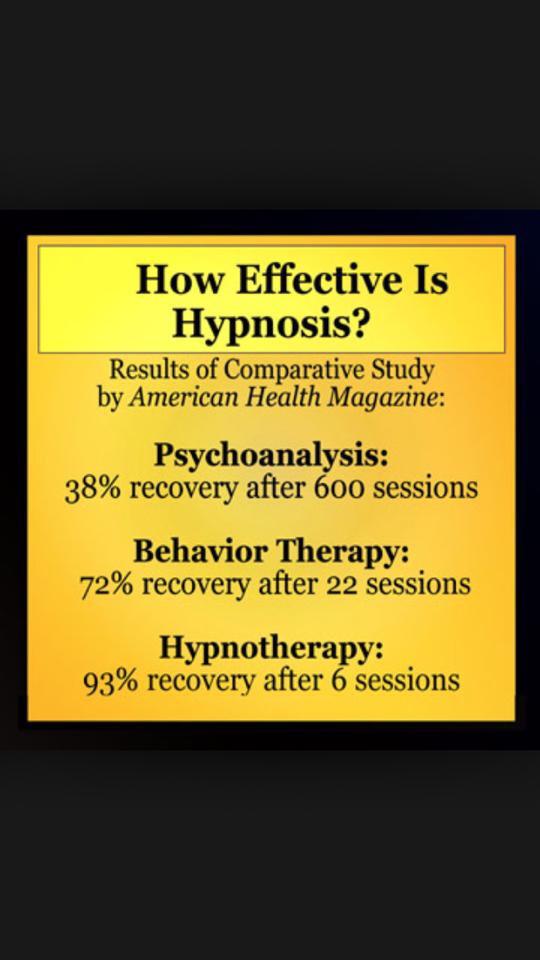
Effectiveness of hypnosis compared to other therapies.


People often ask me if hypnosis works. They want to know how effective hypnosis is.

A modern living room with a white sectional sofa and large windows.

Do I really need to say anything more?