stress

Christmas tree with presents and stockings.
A modern living room with a white sectional sofa and large windows.

Decorations are appearing everywhere, Christmas Carols are playing and events are being added to our calendars. It is the holidays. A time to focus on family, friends and our Spiritual beliefs. So, why do I hear so many people saying how stressed they are? Maybe it is because our focus becomes perfectionism instead?

We create expectations of the perfect decorations, gifts, parties, outfits and they all take their toll on our psyche. At the same time,in many businesses the end of the year means reviews and inventories that increase our workload. Added to this is the financial strains many feel with all of the added expenses. So it seems like “the most wonderful time of the year” becomes “the most stressful time of the year”.

So, what can we do? There are many things we can do to reduce “holiday stress.” This involves making choices. The power of our choices is amazing, when we remember that it is the little things that often make the biggest difference, we understand how big choice is.

So here are some choices you can consider to reduce stress

  • Choose to be money smart. Don’t overspend.Create a reasonable budget and stick to it. Remember it’s not about the presents, it’s about the presence.
  • Choose to keep your expectations balanced. You won’t get everything you want and things will go wrong. Remember thateverything doesn’t have to be perfect and don’t worry about things that are out of your control.
  • Choose to watch your diet and remember to exercise. It’s normal to eat more during the holidays, that doesn’t mean you have to abandon all sensibilities. Be aware of how certain foods affect your mood. If you eat fats and sweets, you will have less energy, which can make you feel more stressed and run down. Therefore, it can be very helpful to take a walk before and/or after a big holiday meal.
  • Choose forgiveness and acceptance. If some of your relatives have always acted out or made you feel bad, chances are they won’t change. If you know what you’re getting into, it will be easier to not let them push your buttons.
  • Choose to limit your commitments to those that you will have the time to enjoy. Eliminate activities or events that cause you to feel rushed or pressured. Fatigue, over scheduling, and taking on too many tasks can dampen your spirits. Learn to say no!
  • Choose to take some time for self-care. Whether it is getting a massage or listening to a hypnosis audio for stress relief, make some “me” time a priority.
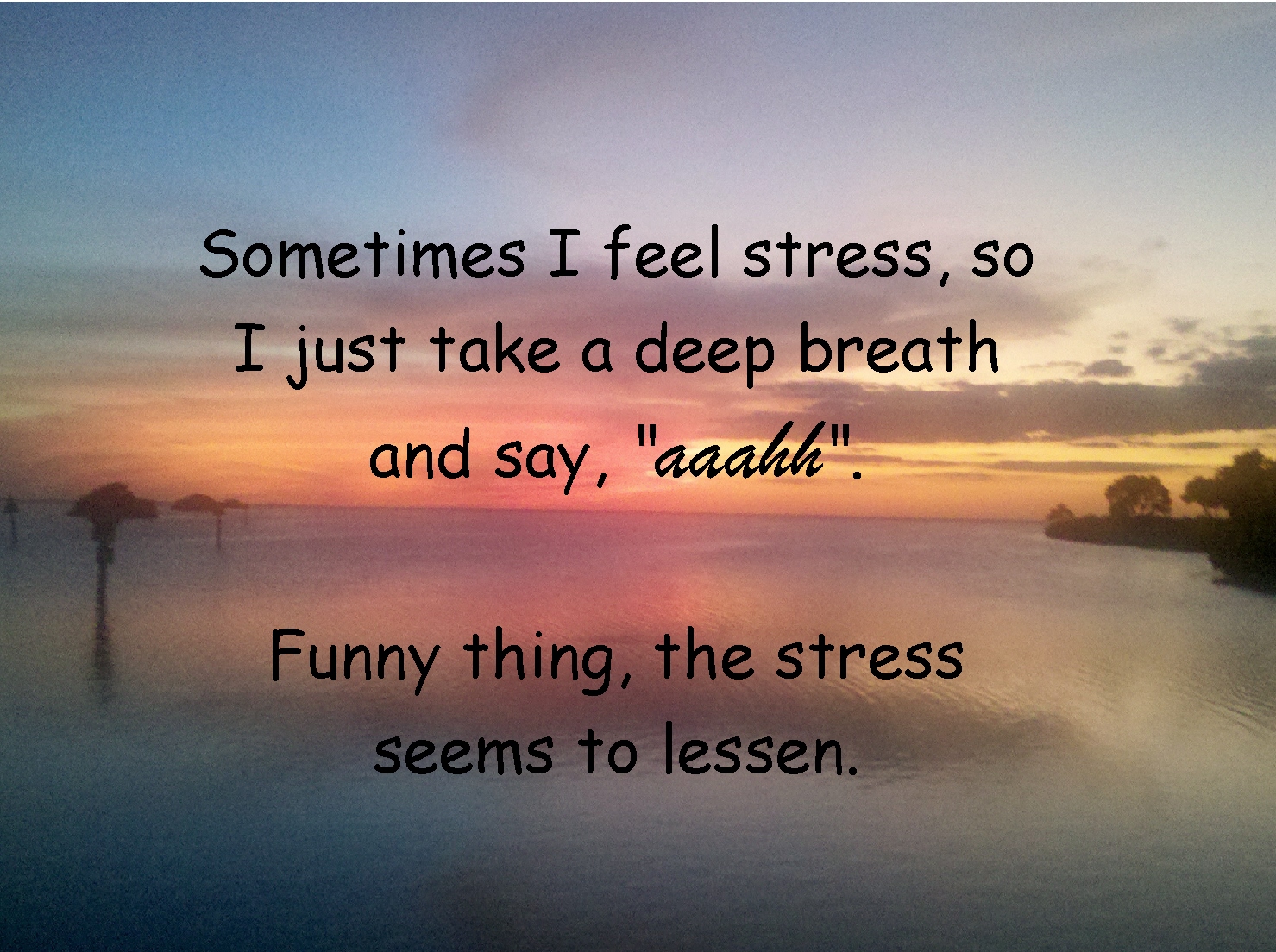
Sunset with stress-relief quote on image.


A modern living room with a white sectional sofa and large windows.

Are you one of the folks who has a crazy busy day from the moment the alarm goes off until it is time once again to go to bed? Do you feel as though everyone else’s needs come first and you never have time for your own wellness? If so, then you are not alone and there is hope for you! For so many people the demands of family, home, work and school can be overwhelming. The thought of adding even one more thing in seems hopeless. The key is to start small and build from there. Add on one small change and when you realize it simply is a part of your routine, it seems less daunting to add the next small change.

Changes even a busy person can make

To me, the easiest thing to add is deep breathes. If you are someone who eats in front of the computer, step away. No matter how stressed, slow down, take three deep breathes before you take the first bite and notice what your meal looks like and smells like. Savor the flavors and the time to tune into what your body is telling you. Then continue to breathe between bites and notice when you’re full. Odds are you’ll end up eating much less (and feeling much better)!

The same thing when racing through traffic, breathe. With construction a familiar sight on the roads and crazy drivers from all over the country, our local traffic can be a real stressor. Stress is one of the biggest enemies of wellness there is. Instead of joining in with anger at your fellow commuters, why not just take some deep breathes each time you stop at a traffic light? Get the oxygen flowing through out your body and leave the stress behind. Listen to some favorite tunes or a good audio book, make the commute your transition time from work to home. You might even put a few drops of lavender oil in the car to get the added benefits of aroma therapy.

While at the office, stand whenever you can. Stand while you take phone calls, if possible walk around. Standing burns twice the calories than sitting and it gets the blood flowing to the extremities. You can also begin to do “deskercise”. For instance, you might keep resistance bands at your desk and between phone calls pull them out for a set of ten reps. Have some filing to do? Why not do squats when putting things away in the lower shelves and cabinets?

Healthy changes for the busy

Instead of meeting for coffee or drinks, begin to live an active lifestyle. Meet a friend to walk and talk or for a game or class. While there may not always be time for a real workout, living actively helps. Spend time dancing or jumping or just plain playing with your kids. That way, you have quality time with them as well as teach them the value of moving the body.

If you are a smoker you are not only doing something unhealthy, but also wasting a lot of time. The average cigarette takes eleven minutes to smoke, while simultaneously taking away eleven minutes of life. So, want to add time on to your day and your life? Trade smoking for anything else that is heathy, legal and nonfattening! Try my favorite health tip once again and breathe deep!

It is helpful to turn off the technology at the end of the day. Take a break from emails and messages and even social media. Your phone, television, and computer all have screens that emit artificial or blue light. Since we spend 90 percent of our waking hours staring at “glowing rectangles,” that’s definitely a problem. This light suppresses the release of melatonin, which helps you fall asleep. You will find you sleep better as a result. Also, it allows you to connect with family at a much better level.

Make your changes personal

There are many more ways that the little things can add up to a big and healthy change. Start with a few of these suggestions and you will soon find yourself creating a list of your own, one that is personal and works for you. No matter how busy you are, if you don’t take time for you, your body will slow you down. So be proactive before it is time to be reactive.

Clutter can be overwhelming for the busy, yet having the time to eliminate it may be hard to find. Still if you are constantly looking for lost items, you are wasting time. If everything is in order, you can get out the door with less stress and more time. Many years ago I found a tremendously helpful website to help the busy clean up and declutter. It is Flylady.

Hypnosis for the busy

Hypnosis can help you find a way to understand your personal priorities and reset your day so that it reflects them. It is also known for the reduction of stress. Let’s face it, less stress makes everything better. I have recorded audios as short as ten minutes for the busy client who wants to make healthy changes for the better. I have also taught many busy people how to use self-hypnosis on the run.

Prism creating rainbow heart on paper.

I am concerned about the many people I have calling me recently about the stress, helplessness and anger they are feeling over the outcome of the election. This is from both sides! Families and friendships have broken up over it. Friends of mine (from both sides of the fence) have posted messages of anger and fear on social media. People speak of feeling betrayed by friends who voted differently.

Post Election Stress Disorder

I have read articles in professional journals recently that others are seeing the same thing. Today I was told about a diagnosis of Post-Election Stress Disorder (PESD).  Like its counterpart PTSD, PESD results when a person is exposed to a traumatic event that overwhelms their normal coping skills.  Common complaints are feelings of shock, dismay, depression, fear, panic and impending doom.  Even this has caused a division, as a veteran who has experienced the horrors of combat or a victim of violent domestic abuse feels it is disingenuous to compare the differing scenarios. What I know is, to the people I speak with their experience is real and they are suffering.

From Survivor to Thriver!

One of the traditional models of treating PTSD, developed by George Everly, PhD, uses a SAFER model to guide one through a crisis. This can be used for PESD as well.  The basic steps are:

  • Stabilize
  • Acknowledge the crisis
  • Facilitate understanding
  • Encourage effective coping
  • Recovery or Referral

Stabilize the situation by turning off the flow of stress, which includes the all-day news channels, social media sites, blogs, tweets and radio rants.  Unfollow political posters for a while. Limit your reading the latest news to a minimum.  For work, develop a list of distracting responses to the question “So, what did you think about the election?”

Acknowledge that this has been a unique experience in our nation’s electoral process.  It isn’t the first time our nation has been at odds, so remember the adage, “May you live in interesting times”. President Kennedy once referenced this in a speech he gave. We survived a Civil War and Nixon’s Watergate.

Facilitate understanding of what took place. It’s normal to have a shock reaction to unexpected events.  The fears and anxieties that are arising are simply the mind’s attempts to find meaning and take comfort in understanding.  Don’t worry about your worries.

Encourage effective coping. Maybe this is not the time to take to Twitter or Facebook and rant about everything that is wrong with the world.  Focus on being the light in a time of darkness. Breathe deep and commit random acts of kindness.  Take a step back and get the wider view.

Recover a sense of normalcy in your life. If you haven’t in the past spent large amounts of time neck-deep in politics, be cautious about submerging yourself into it now.  Swim out of the deep end of political rhetoric and take a walk, listen to music, follow your usual routines. Get back to focusing on chores and the kid’s extracurricular activities.  Rest and restore your energy; you’ve earned it. Listen to a stress relieving hypnosis audio. If, upon awakening, you find your resiliency muscle is in need of a workout, consider referring yourself to a helping professional.

The process of recovery and grieving is not an overnight miracle. However, through hypnosis, changes occur more rapidly than without. It is important to build up your ability to bounce back and to make the shift from survivor to thriver!

The good news is our forefathers had the wisdom to ensure we only go through this process once every four years.

Bay News 9 logo with bright house branding.

This morning a weight client of mine commented how she had not realized that stress had been such a big factor in her weight gain and just how much hypnosis has helped her with her stress. She went on to further say that so many people she knows are stressed and they don’t know that hypnosis could help them! Wait a moment, she didn’t know that hypnosis could help relieve stress? Obviously from the number of clients I see for smoke cessation and weight management my message is out there. But apparently not the whole message. Hypnosis is a wonderful method to use for cutting down on stress!!!

Did you know there is good stress?

Logo with red blocks showing letters TLC and the word 'strategy'.

June is Rebuild Your Life Month, a perfect time to pause and take an honest look at where you are — and where you want to go. Whether life has thrown you an unexpected curveball or you simply feel called to make changes, this month offers a powerful opportunity to recreate your life with intention.

Rebuilding your life doesn’t require drastic moves all at once. Often, meaningful change begins by identifying and removing stressors wherever possible.

Step One: Identify the Source of Your Stress

Recognizing what causes stress in your life is the first and most important step. Job stress often spills over into home life, while a difficult home environment can make work even more stressful. Because stress compounds itself, it’s essential to narrow down where it is coming from so you can address it at the root.

Clear the Clutter to Calm the Mind

Sometimes rebuilding your life starts with something simple — decluttering your home. Numerous studies show that physical clutter contributes to mental clutter, increasing stress and overwhelm.

In The Happiness Project, Gretchen Rubin dedicated an entire month to clearing clutter. She describes how removing excess belongings helped her appreciate what she chose to keep and experience a greater sense of freedom. A clean, organized space often leads to clearer thinking and reduced stress.

Rebuilding Your Life May Require Letting Go of Toxic Relationships

In other cases, stress stems from conflict or unhealthy relationships. This can lead to the difficult realization that certain people in your life may not have your best interests at heart.

Letting go of toxic relationships is rarely easy, and the initial separation can feel stressful. However, removing a consistently negative influence often creates a profound shift in how you experience life. Emotional well-being improves when you protect your peace.

When Your Job Is the Problem

A toxic workplace can be just as damaging as a toxic relationship. While leaving a job may not happen overnight, taking steps toward change is essential.

You spend a significant portion of your life at work, and chronic dissatisfaction can lead to serious emotional and physical health issues. Even beginning to explore new options — changing workplaces or returning to school one class at a time — can improve your outlook and reduce stress.


Healthy Changes That Support Rebuilding Your Life

Healthy Eating

One of the most impactful ways to rebuild your life is by improving your nutrition. Healthy eating supports energy levels, emotional balance, stress management, and long-term wellness.

There is no single “perfect” way to eat, as nutritional needs vary. However, a diet heavy in fast food and processed snacks does not support health or happiness. Choosing nourishing foods is an act of self-respect.

Regular Exercise

Regular exercise is a powerful tool for managing stress, maintaining a healthy weight, and improving emotional well-being. Exercise benefits both the body and the mind.

Psychiatrist Dr. Daniel Amen often says that 20 minutes of vigorous exercise can be more effective than medication for improving mood and brain health. Movement truly is medicine.

Get Quality Sleep

Quality sleep is often overlooked, yet it is essential for rebuilding your life. Stress can interfere with sleep, and lack of sleep makes stress harder to manage — a difficult cycle to break.

Practicing stress-reduction techniques and healthy sleep habits can dramatically improve sleep quality. Self-hypnosis and meditation are especially effective tools for calming the nervous system and promoting restorative sleep.

Create a Happiness Ritual

A happiness ritual is a simple, repeatable activity that brings you joy. It might be a daily cup of tea, quiet reflection, journaling, coloring, yoga, or time in nature.

Practicing your ritual regularly reinforces your sense of worth and creates emotional resilience. When stressful moments arise, you can draw on the calm and comfort you’ve cultivated.


Rebuilding Your Life Starts With Small, Intentional Choices

Life was never promised to be easy, but it is responsive to the choices we make. Rebuilding your life can begin with decluttering your space, changing relationships, improving habits, or simply deciding that your well-being matters.

By adjusting your sails and choosing a new direction, you move away from the past and toward a healthier future. Use this month as your starting point. The life you rebuild may surprise you.

Sunset with stress-relief quote overlay.

How would you like a simple stress release exercise that helps calm anxious feelings — one that’s easy, effective, and even a little fun?

Imagine being able to release stress wherever you are: at home, in your car, or at the office. No equipment. No special preparation. Just a quick mind-body reset when you need it most.

Research on mind-body techniques shows that simple physical actions combined with focused imagination can help relieve stress and anxiety by calming the nervous system. This exercise is designed to do exactly that.

Step One: Acknowledge the Feeling

Begin by noticing what you’re feeling. Anxiety, nervousness, fear, or even panic — simply acknowledge it without judging yourself.

Allow the feeling to be present. Remember, it is just a feeling, and feelings themselves cannot harm you.

Step Two: Contain the Stress

Now, close your left hand (the hand you write with) into a fist. Make it tight. Really squeeze and feel the pressure.

As you do this, imagine all of your anxious feelings slowly flowing down your arm and into your clenched fist.

If it helps, visualize the anxiety as a red, glowing energy traveling down your arm and becoming trapped in your fist. Make the image as real as possible. You may notice sensations such as pulsing, warmth, or pressure — this is normal.

Step Three: Transform the Energy

As the energy gathers in your fist, begin to notice a shift. The anxiety may soften into a manageable nervous excitement.

You might imagine the color changing — from red to pink, or even to a calming blue. Let the sensations evolve naturally.

Step Four: Release and Let Go

Now for the final step.

Slowly begin to open your fist, one finger at a time, counting from 5 down to 1. Take a gentle breath with each finger as it opens.

As your hand opens fully, notice the tension releasing. The trapped anxiety is being set free.

With one final deep breath, blow gently onto the palm of your hand, sending the stress, fear, and tension away.

Step Five: Notice the Release

Take a moment to notice how you feel. You may experience a light sense of relief or calm.

You can imagine the remaining anxiety floating up, up, and away — carried off into the sky and out of your awareness.

Repeat this simple stress release exercise up to three times, and notice how much better you feel.

Extra Support for Stress Relief

If you’d like additional guidance, you can also tune into a free stress-relief audio here: Serenity.

Red spiky flowers with green leaves.
“My life has been filled with terrible misfortunes, most of which have never happened.” ~Mark Twain
This quote is a perfect illustration of why cognitive reframing for stress can be so powerful.
 

Have you ever noticed how a single shift in perspective can suddenly make life feel easier? Cognitive reframing for stress is the process of changing how we interpret situations so our nervous system responds differently. A simple change in thought can reduce anxiety, restore clarity, and completely alter how a day unfolds — as I was reminded recently by an unexpected fall.

Suddenly, your perspective changes.
Your mood lifts.
Things feel… easier.

That shift is called cognitive reframing.

How Thoughts Shape Stress and Clarity

Stress can increase or decrease based largely on our thoughts. Anxiety, stress, and irrational thinking shape how we experience daily life and how we respond to situations.

The body’s stress response isn’t triggered by events themselves — it’s triggered by perceived stress. Reframing thoughts can literally change physical stress reactions, helping restore emotional balance and mental clarity.

This kind of reframing happens often in my office. I teach it, talk about it, and encourage it regularly. One might assume that means I live in a perpetual state of positive thinking.

I wish.

Sharing this story feels vulnerable, but it matters. Because we’re all human — and we’re all in this together.

The Bike Ride and the Fall

This past Saturday, my husband Greg and I went for a bike ride. Cycling has always been a source of exercise and mood enhancement for both of us. We’ve logged many miles over the years.

I had recently been ill and wasn’t fully back to my normal strength, but I was determined to push through.

At one point, Greg noticed beautiful flowers tucked into a clump of trees and asked me to turn around so we could look more closely. Normally, this would have been easy.

Instead, my balance failed me — and I fell.

I lay on the ground with tears in my eyes, more from humiliation than pain.

When Thoughts Spiral

Once I got up, I truly enjoyed the flowers and even took several photos. In that moment, everything felt fine.

But as we got back on our bikes, my thoughts took over.

I felt old.
Clumsy.
Stupid.

At our next stop, I began lamenting my condition to Greg.

Thankfully, Greg would have none of it.

A Reframe That Changed Everything

He reminded me of a recent conversation with his clients — people who had suffered from the same virus I had. Many were younger, stronger, more balanced — and many struggled longer than I did.

The fact that I was out riding at all was a testament to my immune system and determination.

That simple reframe changed everything.

Suddenly, it was as if the sun rose — though it had been shining all along.

Clarity Returns

We were riding along a beach causeway. I noticed families playing, children laughing, brilliant colors, a warm breeze, the sound of water — and yes, a dolphin swimming nearby.

My thoughts shifted to confident, grateful ones.

I felt strong again.
Present.
Clear.

I was simply happy to be there.

One Thought Can Change a Day

Nothing about my physical situation changed — except my thoughts.

A single cognitive reframe turned frustration into appreciation and restored clarity and peace.

Can you think of ways your thoughts might help improve your day?


Chewed pencil end with eraser and ferrule.
April 16 (the day after Tax Day, April 15) has become a special day to set aside for Americans to become aware of just how stressed they may have become! Everyone feels stressed from time to time and if left unchecked, it tends to be a real happiness killer as well as a threat to your health. This makes it harder for us to live joy-filled lives. Stress has also been reported to lead to a number of major health problems, ranging anywhere from anxiety or severe depression to physical symptoms such as a mild case of acne to life-threatening heart attacks. It is easy to see why it is so vitally important to keep life’s major stressors in check.
Scientists report that psychological stress may exact its toll, at least in part, by affecting molecules believed to play a key role in cellular aging and possibly, disease development.  Anecdotal evidence and scientific evidence has have suggested that chronic stress can take years off your life. Stress can also have an indirect effect on the immune system as a person may use unhealthy behavioral coping strategies to reduce their stress, such as drinking and smoking. It is easy to see why it is so vitally important to keep life’s major stressors in check.
Enough of the dire news and warnings, I don’t need to stress you out more.
Instead, here are some quick tips for changing into a stress free zone for the day and at the end a link  to 3 free audios I have available for you to reduce your stress!

1. Focus On The Now

So many people live their entire lives in yesterday or tomorrow. The truth is, however, that there is only the Now. Focusing on this moment, right now, provides a wonderful escape from the disappointment of what once was and the fear of what might be, leaving stress stuck in a time warp. (You do remember the Time Warp, right?)

2.   Give Yourself A Pep Talk
Sometimes a good talking to is all you need to keep stress at bay. Maybe it is about time you gave yourself a pep talk, reminding yourself what is right with your life instead of dwelling on what’s wrong. Ask yourself how you got so lucky to have a roof over your head, food on the table and the opportunity to experience so much each day.

3.     Get the Giggles
Laughter really is the best medicine. Watch a comedy, share a funny joke, or go to a card shop and read funny cards. I always told my sons to find a reason to smile and laugh as they walked out the door. Maybe you can do the same, then share whatever it is, give yourself time for laughter each and every day.

4.     Use Self-Hypnosis
A still mind is a stress-free mind, so take a deep breath, quiet your thoughts and let the stress melt away. Even ten minutes done daily for the next 30 days will do wonders for releasing stress in your life.

5.     Keep a Happiness Journal
Starting today, spend a few minutes reflecting on the day you just experienced and list five things about the day that delighted you. Review that list when tempted to return to the old stinking thinking track.

6.     Lend  A Helping Hand
Sometimes the best way to deal with stress is by providing relief to someone else. Placing your focus on others needs takes the focus off your own challenges. This will lead to less rumination and therefore less stress. So look around you, see who needs a hand up and offer yours.

7.     Listen To A Hypnosis Audio
I have three audios I have created that are free for you. Just stop by anytime to listen. Share them with your friends, let’s get this stress-less party started! Stress Free Audios

Silver trophy engraved with Angel Award 2016 for Debbie Lane.
Tampa made a top 10 list, in fact it made it to the number one spot! But, not a list we like to brag about around here. 
 
Sperling’s BestPlaces, a research firm specializing in livability rankings, has released its new study of major cities with the most and least stress.  The study analyzed a variety of factors associated with stress, including suicide, divorce, crime, joblessness and lengthy commuting. 
With that in mind, I decided to do my part to help reduce the stress. It may not be the cure, but if it even helps change one attitude, I believe the butterfly effect may begin.

 Click Here For Calm

Be sure you have a few minutes to enjoy, uninterrupted. Then please, share with anyone you might know that could use a moment of comfort. 

Young man smiling with text about expected clients and clicking to download.

While walking this morning, I noticed birds above flying in a way that just appeared to be so free. Perhaps they were scouting for food, but by all appearances, they were just enjoying the winds and floating in circles. That made me smile. I had an amazing weekend, which followed the most wonderful experience on Friday. You see, on Friday, I was invited to shadow Dr. Cesar Lara.
Dr. Lara is a local family practitioner who specializes in weight management. We have begun working together and he felt I could better understand what it is he does, by observing him in action. Every hypnotist ought to have the same opportunity! Meeting with his patients, hearing their concerns and observing the gentle yet clear manner he communicates with them was inspiring. Furthermore, I always enjoy learning more about the science of medicine. Dr. Lara respectfully asked for my input. In just a few short moments, I could observe big changes occurring in the thoughts behind behaviors of these individuals.

Something I did notice is how the current “scarcity” mentality is affecting people’s weight. People are stressed, which in turn affects their sleep. Not enough sleep has been identified as a factor in weight gain. Furthermore, midnight snacking often occurs when sleep is interrupted.

Another reaction to stress is the release of cortisol by the adrenal glands. One of the functions of cortisol is to trigger a production of blood sugar from proteins. Excess glucose is then used for fat production. This increases fat storage in the body.

An additional outcome of scarcity thinking is that we tend to hoard. Why, there was even a report today on my local news station (10Connects) that there has been a reduction of trash recently due to the economy! Hoarding occurs on our bodies as well. We hold on to extra weight at a subconscious level because we fear not having enough food later. We over eat because we fear lack.

Nature is amazing in it’s abundance. When I look at my orange tree, it never produces just “the one” orange. It produces so many oranges that we have to give them to everyone we can. My son has recently laughingly reminded me that nature is
abundant with the generous amounts of pollen we have had to sweep from our drive daily. Sunsets are never ending. The number of seagulls every time I visit the beach, more than enough, thank you very much!

I realized that sometimes I do the same thing. I eat beyond the point of satisfaction, because at some level I believe I may never get to enjoy the wonderful dish before me again. Yet, in reality, there is always another dish set before me of equal enjoyment the very next meal. It is time for me to be very aware of mindful practice in eating. I will eat just a little less, trusting that I will always have another perfect meal.

1 2 3